
What to Document on a Multifamily Construction Project
Multifamily development sits at the intersection of construction progress, investor reporting, and pre-leasing marketing. Here's what's worth documenting from the air on these projects specifically.
Multifamily development has a documentation problem most other construction project types don't share: the imagery needs to work for construction tracking, investor reporting, and marketing simultaneously, often before the building is even finished.
A developer building a 200-unit apartment complex isn't just managing a construction schedule. They're likely reporting to investors or a lender, coordinating phased unit turnovers, and, in many cases, already pre-leasing units before the project reaches completion. That combination changes what's worth capturing from the air compared to a standard commercial build.
Phased Building Completion and Turnover
Multifamily projects rarely finish all at once. Buildings within a development are often completed and turned over in phases, allowing leasing and occupancy to begin on finished buildings while construction continues elsewhere on the site.
Aerial documentation is particularly useful here for tracking:
Building-by-building progress, since different structures within the same development are often at very different stages simultaneously
Completion sequencing, confirming which buildings are tracking toward their planned turnover dates
Site separation, documenting the boundary between occupied or leasing-ready buildings and active construction areas
Common area and amenity progress, which often lags behind individual units but matters significantly for leasing and resident experience
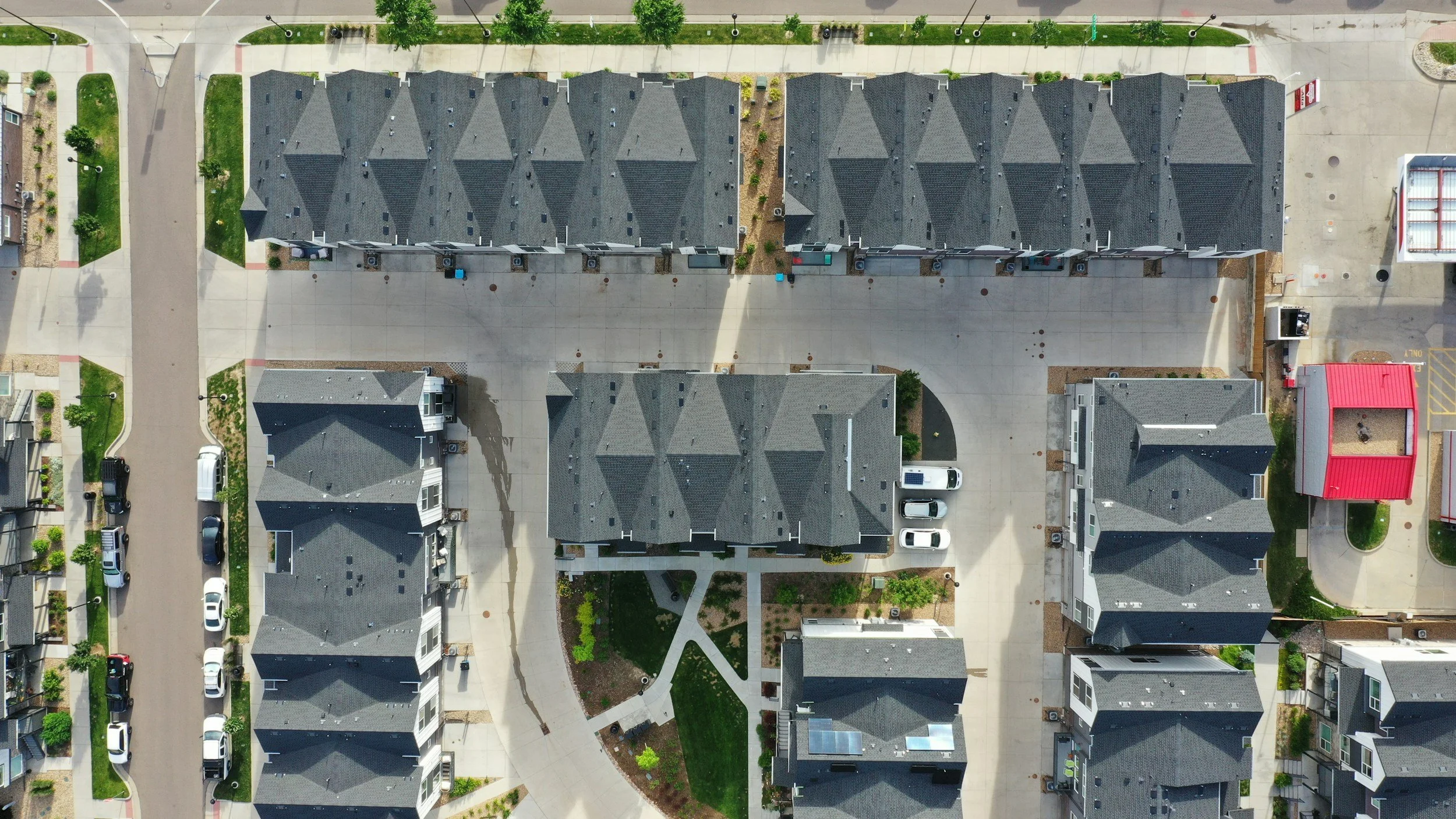
For a large multifamily site, a single ground-level photo can rarely capture this kind of building-by-building status. An aerial view showing the entire property at once makes phased progress far easier to track and communicate.
Investor and Lender Reporting
Multifamily development is frequently financed through construction loans and investor capital, which brings similar documentation needs to what we've covered for developers and lenders generally but with some multifamily-specific wrinkles.
Useful documentation for this audience includes:
Progress tied to construction loan draw schedules, particularly for large developments with phased draws
Building-level completion percentage, since investors often want to understand which phases are closest to generating leasing revenue
Consistent imagery that supports quarterly or milestone-based investor updates
A visual record that can support refinancing conversations or future capital raises for the developer's next project
Because multifamily projects often involve multiple capital partners with different reporting expectations, having one consistent, well-organized set of aerial documentation can save significant time compared to producing separate materials for each stakeholder.
Pre-Leasing and Marketing Support
This is where multifamily construction documentation diverges most from other project types. Many developers begin marketing and pre-leasing units well before construction is complete, which means construction imagery often needs to double as marketing material.
Aerial capture can support this in a few ways:
Progress imagery for a pre-leasing website or leasing office, giving prospective residents a sense of the property taking shape
Amenity and common area progress, which tends to be especially compelling for prospective residents evaluating a still-under-construction property
Neighborhood and location context, showing the property's relationship to surrounding amenities, transit, or landmarks
A visual progress timeline that can be used in marketing materials to build anticipation ahead of the leasing launch
This dual purpose is worth planning for explicitly. A capture plan built purely for internal construction tracking may miss the more polished, presentation-ready angles a leasing team would want, while a plan built purely for marketing may not provide the consistent, dated documentation a lender needs. The strongest programs account for both from the start.
Milestones Specific to Multifamily Projects
Beyond the general construction milestones common to most projects, multifamily developments have their own particularly important phases to document:
Site grading and infrastructure for a multi-building development
Building-by-building structural progress
Exterior finishes and building envelope completion, often staggered across buildings
Amenity spaces: pools, clubhouses, fitness centers, and other shared facilities
Parking structures and site circulation
Landscaping and exterior common areas
Building-specific certificates of occupancy and turnover readiness
Because these milestones often happen on different timelines across different buildings within the same development, a monitoring program needs to be flexible enough to track multiple simultaneous phases rather than treating the site as a single, uniform project.
Site Logistics Across a Larger Footprint
Multifamily developments frequently cover more ground than a single commercial building, which makes aerial perspective especially valuable for logistics:
Material staging and equipment across a multi-building site
Access and circulation as different areas open and close to construction traffic
Coordination between multiple trades working simultaneously on different buildings
Site security and fencing as portions of the property become occupied
Building a Monitoring Program for Multifamily Development
Given the multiple audiences this imagery typically serves, a well-structured multifamily monitoring program usually includes:
A capture schedule flexible enough to track building-by-building progress rather than a single uniform pace
Alignment with construction loan draw schedules where applicable
A mix of operational documentation and more polished, marketing-ready imagery
Consistent viewpoints established early enough to support a pre-leasing marketing timeline
Deliverables organized in a way that different teams — construction, finance, and marketing — can each use without requesting separate captures
Frequently Asked Questions
Can the same aerial footage be used for construction tracking and pre-leasing marketing? Often yes, if the capture plan is designed with both purposes in mind from the start — this typically means combining consistent, dated progress documentation with a few more polished, presentation-ready angles at each visit.
How often should a multifamily development be documented? This depends on the project's size and pace, but many multifamily developments benefit from biweekly monitoring, with additional capture aligned to draw schedules or major building milestones.
Should each building in a multifamily development be tracked separately? For larger developments with staggered completion timelines, yes, tracking progress building by building tends to be more useful than treating the entire site as a single uniform project.
Aerial Documentation for Multifamily Development
Multifamily construction needs documentation that works for the construction team, the capital partners, and the leasing team, often all at once.
West Coast Drone Operations works with multifamily developers across Southern California to build monitoring programs that support construction tracking, investor reporting, and pre-leasing marketing from a single, well-planned capture schedule.
Developing a multifamily project?